

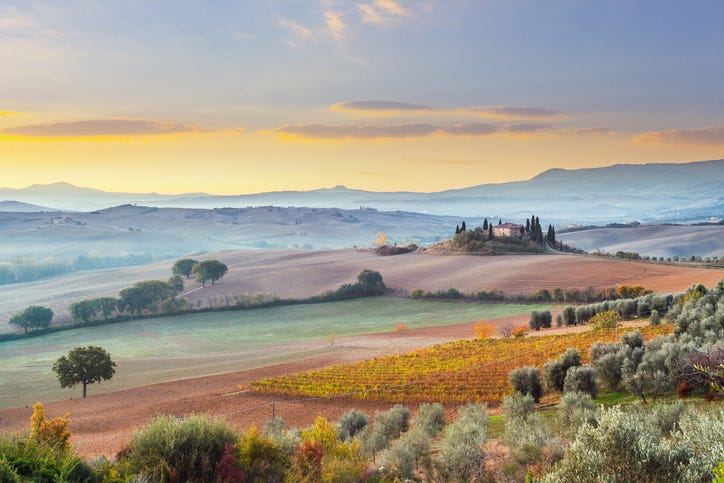
“Perhaps even these things, one day, will be pleasing to remember.”
~ Virgil (70-19 BC)
Joel Bowman, with today’s Note From the End of the World: Buenos Aires, Argentina…
With the holidays nigh upon us, we count the tasks outstanding against the year’s twilight hours and discover, without surprise, that the former far outnumber the latter.
There are deadlines to meet... invitations to send... victuals to prepare... libations to sup... and of course, friends and family to gather near (such as geography and busy schedules permit).
No doubt you’ve plenty on your own proverbial plate, too. Allow us, therefore, to relieve one item from your brimming to-do list. Or at least, to offer up a humble suggestion, on behalf of one of our favorite poets...
Publius Vergilius Maro, known more commonly as Virgil, was born in 70 BC in what the Romans knew as Cisalpine Gaul, today’s northern, alpine Italy. Before he passed into the realm of the shades, just half a century later, Virgil had composed three of the most important poems in Latin literature: the Eclogues (or Bucolics), the Georgics, and of course the foundational epic, the Aeneid.
In this second work, which follows the tensions of the seasons and man’s struggle with, and eventual triumph over, the havoc and danger of the natural world, Virgil presents a masterpiece at turns didactic, elegiac, epic and even (as in the tale of Orpheus and Eurydice) epyllion. Loosely modeled on (the Greek poet) Hesiod’s famous Works and Days (composed around 700-650 BC), Virgil’s own poem muses on the classic, universal dichotomies of myth and reality, power and politics, cause and effect, heaven and earth, love and loss, life and death...
Under a Tuscan Sun
Many modern moons ago, having once again taken to wandering the world as a homeless peripatetic, your flâneuring correspondent found himself holed up in the ancient township of Città di Cortona, in Tuscany.
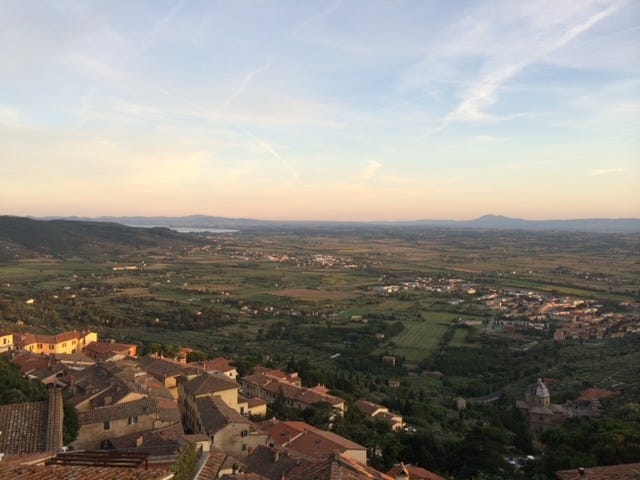
The fortified hamlet sits atop a picturesque Italian hillside, which overlooks the same fertile plains as once viewed by the Etruscans... the Romans... perhaps even Virgil himself (who would have traveled south to Rome and onto the port city of Brundisium, modern day Brindisi, where he eventually gave up the ghost).
Perched on a fine little Juliette balcony, we lazed one afternoon under a late Tuscan sun, Sangiovese (literally: “blood of Jove”) within easy reach. Through the wrought iron we scanned the plains below, plowed through the ages by man and beast, tiny clumps and copses scattered between the fields, green and fallow. Virgil’s work lay open in our lap, Book I...
It is from the first book of the Georgics, in part a supplication to the Gods (as well as Augustus himself), that we recite our yearly Thanksgiving toast, remembering always those who went before us... as well as the halcyon days in Virgil’s birth country... and the longed-for future, when we will venture there once more. Please enjoy the immortal poet’s words, below…
A Thanksgiving toast, from Virgil’s Georgics, Book I
What makes a plenteous Harvest, when to turn
The fruitful Soil, and when to sowe the Corn;
The Care of Sheep, of Oxen, and of Kine;
And how to raise on Elms the teeming Vine:
The Birth and Genius of the frugal Bee,
I sing, Mecaenas, and I sing to thee.
Ye Deities! who Fields and Plains protect,
Who rule the Seasons, and the Year direct;
Bacchus and fost'ring Ceres, Pow'rs Divine,
Who gave us Corn for Mast, for Water Wine.
Ye Fawns, propitious to the Rural Swains,
Ye Nymphs that haunt the Mountains and the Plains,
Join in my Work, and to my Numbers bring
Your needful Succour, for your Gifts I sing.
(As translated by the English poet, John Dryden, 1631-1700)
Finally today…
A very special thanks, as always, to all our of dear Notes readers, who now hail from all 50 US states and from 139 countries around the world!
Whether you reside in the US or not, we’re extending our gratitude to all by offering a rare 30% Off Notes Membership special… but only until midnight this Sunday.
So if you value our work and would like to help spread the message of Free Markets, Free Minds and Free People, there’s never been a better time to get on board. Grab your special offer – which you lock in for life – before the holiday crazies set in, today…
Whatever you’re up to this Thanksgiving, we hope you’re enjoying it with family and friends.
Cheers,
Joel Bowman