
A Sum Without Limit
On connectivity, stupidity and the nature of mankind...

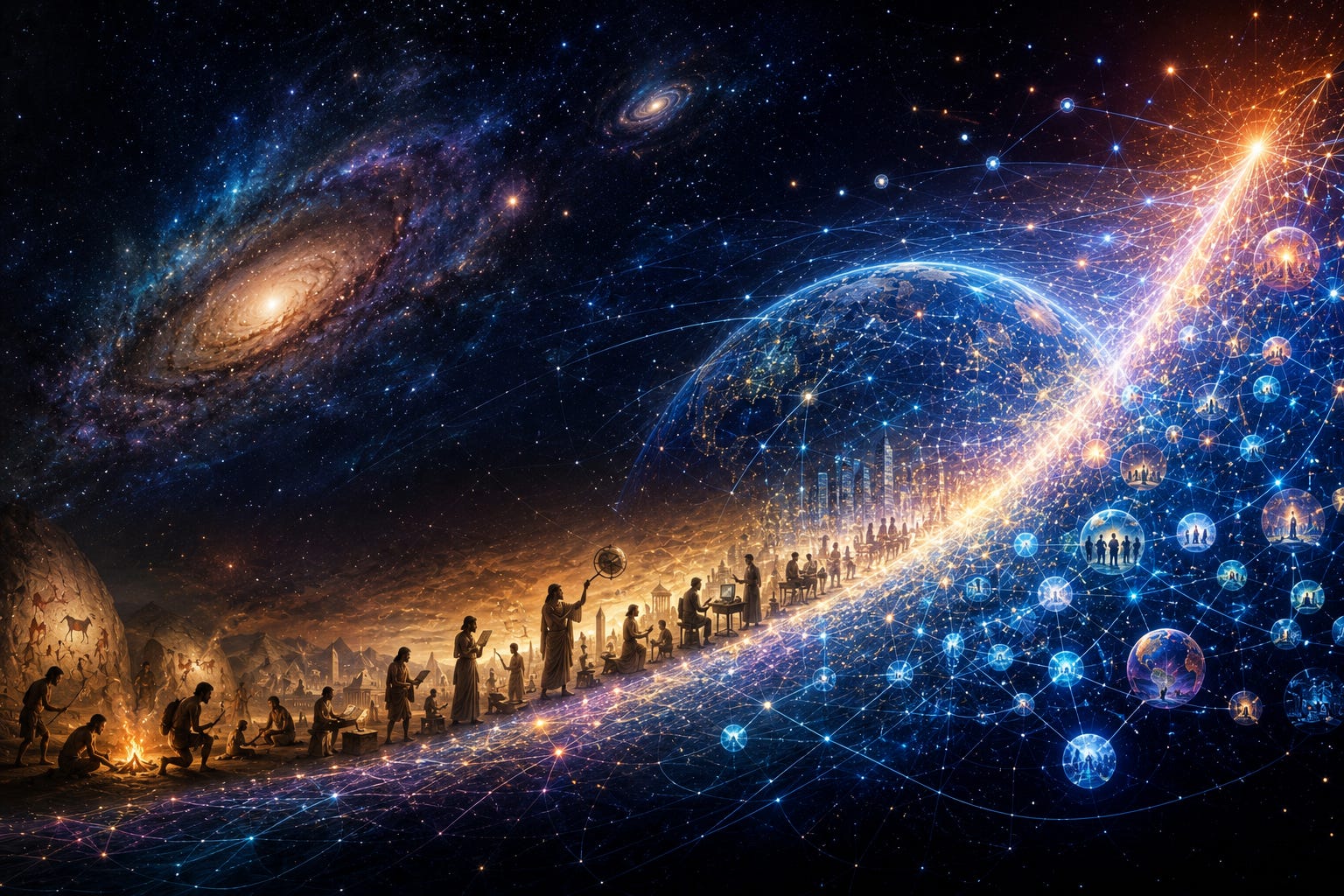
“The sum of things is bounded by no limit.”
~ Lucretius, De Rerum Natura, Book I (c. 60–55 BCE)
Joel Bowman with today’s Notes From the End of the World: Buenos Aires, Argentina...
Once upon a time, in another world, a magical world, the future still felt like it was a long way away.
Now, it seems like it can’t come quickly enough!
One has only to pick up the paper to read stories of breathtaking ambition and profound stupidity.
Why, just in today’s New York Times...
One headline asks whether “Canada is about to enter the Eurovision song contest?” Another wonders if it’s “time for a new sexual revolution?”
One inquires “what’s behind those tarps at the Kennedy Center?” Another fearless mind probes “where has all the cottage cheese gone?”
Behold, dear reader, the pressing concerns of our day!
And lo! What’s this?
Rockets and Riches
No sooner had the world minted its very first trillionaire, in Mr. Elon Musk, when his “13-figure club card” was unceremoniously revoked. Naturally, the green-eyed papers are delighted by the demotion:
Elon Musk’s Net Worth Drops $350 Billion In Massive SpaceX Selloff ~ gloats Forbes
Elon Musk loses trillionaire status as global tech rout hits SpaceX ~ crows the BBC
Musk loses trillionaire status as SpaceX shares ‘come down to earth with a bump’ ~ gushes The Guardian
And just for good measure, via a report from the kind of people who study such things, we learn that xAI is “leaning into explicit content.” Here’s Forbes, “psst, passing is on”:
Grok’s Traffic Is Mostly Driven By Adult Content, Report Says
The report claims xAI is actively doubling down on its explicit video and image-generation tools and that adult-content dominance extends into Grok’s coding model, which The Information reports frequently receives requests for pornographic material.
So the man is into big rockets, cyber trucks and nudie pics? A man’s gotta have a hobby, doesn’t he? (Your editor enjoys slow train rides, comfy old sweaters and dusty books. Ahem...)
Leaving the Freudian psychoanalysts to their own diagnoses, we pause only to marvel at the kind of civilization that would make such a fellow the richest person – by a wide margin – in its long and sordid history?
Oh, the times we live in!
Speaking of...
Political Animals
In Wednesday’s Note, we left you with a humble suggestion for a new measurement of time: Human Years.
Instead of measuring time by days, months, years and so forth, we mused, perhaps we might think of it in terms of “aggregate human experience.” Or calendar time multiplied by the number of human beings living it.
And why not?
Geologists have deep time. Astronomers have cosmic time. Physicists have space time.
What about us? We wide-eyed observers of the passing parade?
A 12-hour clock is useful for making sure you arrive at the train station on time. A monthly planner is helpful when booking a vacation. A calendar year is practical for organizing your Christmas cards and counting the candles on your daughter’s birthday cake.
But what about the collective, human experience? What about considering the broad sweep of civilization itself?
How does a day planner... or a news cycle... or a sun dial... help us understand the rise and fall of empires, the decay of their currencies, the great cycles of history itself?
They can help us pinpoint a moment in relative time... but what if, as the population grows, history literally speeds up?
When Caesar crossed the Rubicon, back in 49 BC, the world population stood at about 170 million, hardly more people than voted in the last US presidential election.
That we have 8.2 billion men, women and children roaming the planet today... about 48x the population alive during Caesar’s day... is only part of the story.
Human beings, as Aristotle so keenly observed, are by nature “political animals.”
By that he did not mean that we are all Republicans or Democrats, Tories or Whigs, RINOs or libtards, but rather that we are essentially creatures of the polis... the broader civic community that helps shape our lives. That includes our institutions, our laws and customs, our liberties and obligations, our cultures and habits, as well as our public deliberations, general elections and other such popular, mass delusions.
In this way, civilization is less like a stack of building blocks and more like a vast network of interconnected individuals, exchanging information across time and space, through billions of interactions, from one End of the World to another.
Laws and Large Numbers
Which brings us to another piece of the puzzle: Metcalf’s Law, or what armchair economists sometimes refer to as the “network effect.” Robert Metcalfe, inventor of Ethernet, distilled his proposition as following:
The value of a network is proportional to the square of the number of its users.
The basic idea here rests on the concept of non-linearity. You throw a Fourth of July cocktail party. One sympathetic friend arrives. Early. They’ve created one possible two-way line of conversation. Then the second guest arrives. Now you have three possible pairings. After the fourth, you have six. The fifth, ten. And so on...
By the time fifty of your closest mates are gathered on your back lawn, you’ve got over a thousand (1,225) possible duos.
Thus, under Metcalf’s Law, value is said to grow quadratically, so that:
Guest #10 adds 9 new potential connections
Guest #100 adds 99 new potential connections
Guest #1,000 adds 999 new possible connections
And if we keep counting to include all possible connections – pairs, trios, small groups, large groups, whole teams, etcetera... right up to all 50 guests shouting at one another simultaneously – the possible combinations increase to...
...several trillion (1.126 quadrillion, or 1,125,899,906,842,572).
The same mind-boggling math is true across various other kinds of networks, too... whether it be communications, operating systems, social media, dynamic marketplaces, payment systems and even the vast network called civilization itself. Not only does each additional participant bring their own individual value, but they increase the potential value of every preceding person in the entire community.
Across the Rubicon
In Caesar’s day, that community fanned across the “known world.” Today, with nearly fifty times as many people and a density of connections unimaginable to the ancients, civilization has grown into the largest and most intricate information network ever assembled.
During the five minutes it takes you to scan today’s pithy Note, for example, the world’s population will grow by approximately 650 people. Using Metcalf’s Law, and factoring in our existing population, that’s 5.33 trillion new potential human pairs created just while you finish your cup of coffee/glass of wine.
Every minute... of every hour... of every day... unfathomable waves of budding partnerships, lurking rivalries, nascent collaborations, and looming conflicts are building on humanity’s horizon.
And if we expand our counting as we did for your hypothetical garden party, to include every new possible grouping of three, four, five, etc. ... all the way up to an 8.2 billion person (plus 650 newbies) collaboration?
The number of new possible human connections created by these new earthly arrivals grows to hundreds of orders of magnitude greater than the estimated number of atoms in the observable universe. No kidding.
Surely one of ‘em can figure out where all the cottage cheese went, no?
Stay tuned for more Notes From the End of the World...
Cheers,
Joel Bowman
P.S. As always, a huge THANKS to our growing community of Notes members. Your support keeps our midnight oil burning and our sweater elbows patched.
If you’re not yet a member but would like to show your appreciation, kindly consider joining our growing rolls today. Every new member adds immeasurable value to our humble enterprise. Cheers ~ JB
Sadly, today, at your hypothetical cocktail party, most of your guests will be found, shortly after arrival, in some corner staring at their phone, thus limiting interactions with others. Some might argue that they are interacting on their phones, but I would respond that doom-scrolling is not interacting.
Thank you for validating my decision to be a hermit. My current physical exposure to the world is limited to the good folks at the local post office, the feed & farm store and the supermarket. That seems like enough. I might run into a neighbor once every couple of months, but I can handle it.