
Clash of the Titans
Musk, Trump and the best government money can buy...

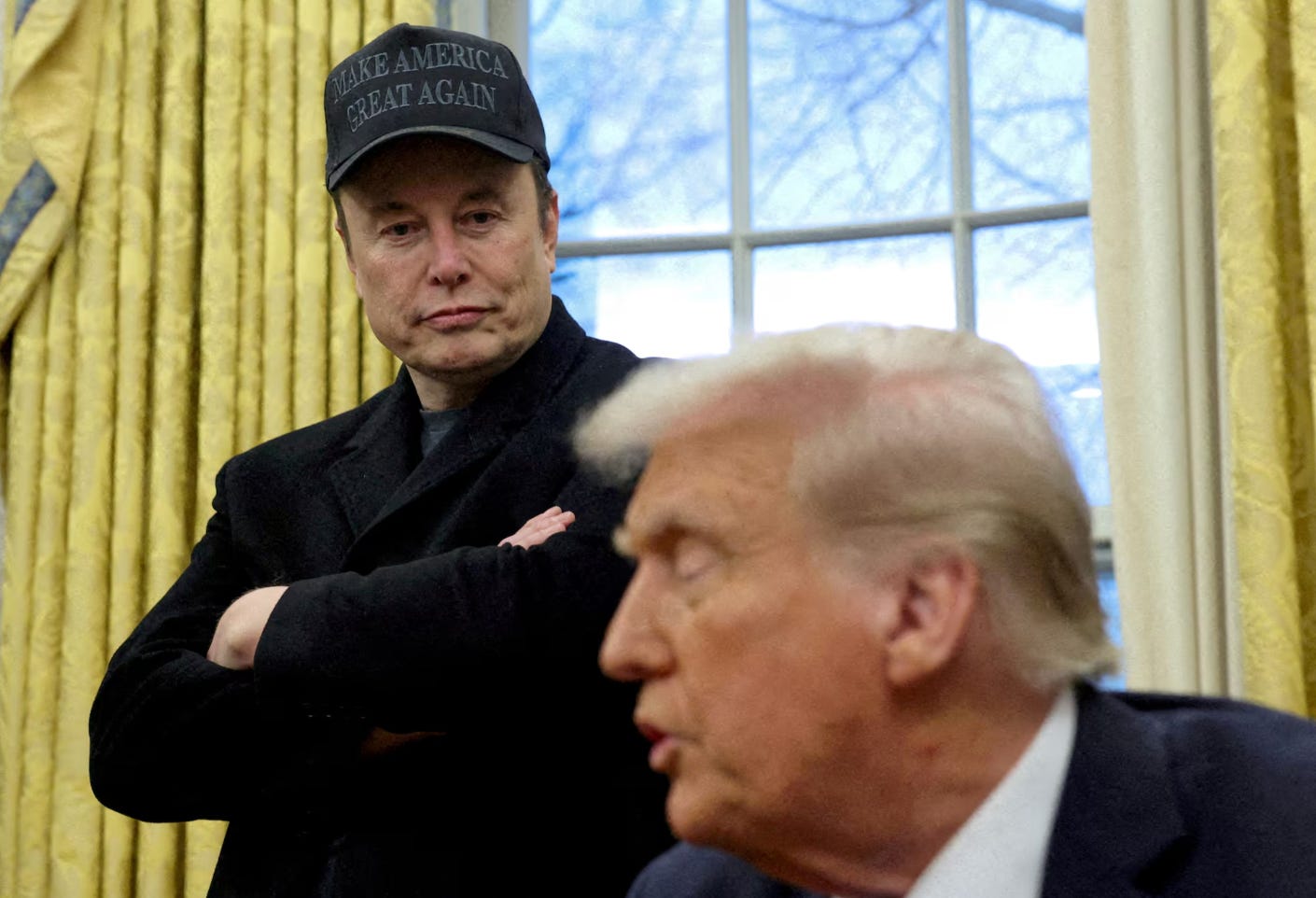
“Our democracy is not perfect, but we do have the best government money can buy.”
~ (Attributed to) Mark Twain
Joel Bowman with today’s Note From the End of the World: Syros, Greece...
By now you’ve heard the news, dear reader. The Musk-Trump bromance is officially, spectacularly over... and the Internets are having a field day.
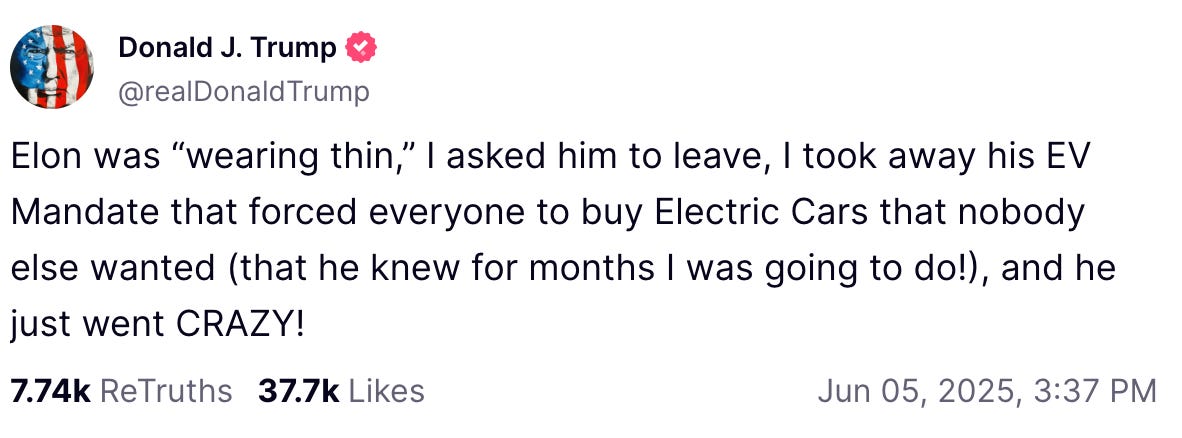
Barely a week after Elon Musk revealed he was "disappointed" in President Trump’s Big Beautiful Bill (from X:“I think a bill can be big or it can be beautiful... but I don’t know if it can be both.”) the richest man on the planet and the leader of the free world were at each others’ throats, lashing out with threats and epithets enough to make a Kardashian blush.
Following some initial barbs and thinly veiled jibes, tensions escalated until Trump shot off the following on his Truth Social platform:
Came the counter attack from Musk, not half an hour later...
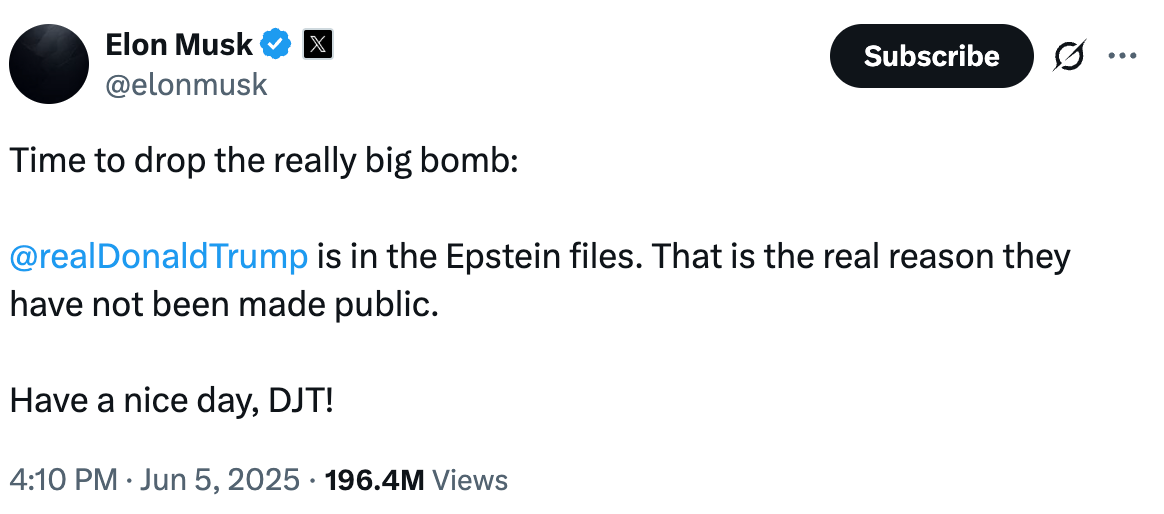
As one commentator remarked, “once you take the pin out of the grenade, there’s no putting it back in.” This was war.
Fired Trump:
“The easiest way to save money in our Budget, Billions and Billions of Dollars, is to terminate Elon’s Governmental Subsidies and Contracts. I was always surprised that Biden didn’t do it!”
Replied Musk:
“Go ahead, make my day.”
The man with the rockets went on to further up the ante, noting that such a move would effectively both end the International Space Station... and simultaneously provide no way to safely deorbit it.
“In light of the President’s statement about cancellation of my government contracts, @SpaceX will begin decommissioning its Dragon spacecraft immediately.”
Big Beautiful Breakup
Whoa! So rapid fire is the escalation, so volatile and unpredictable the egos involved, that by the time you read this, the pair will either have gone full nuclear... or be enjoying a post-makeup cigarette.
Of course, in a battle royale of such epic proportions, everyone has his own axe to grind and petty agenda to advance...
Thus some sought to frame the “Big Beautiful Breakup” as the first public divorce of pride month... while others wondered who might get J.D. Vance in the divorce... and a few dark humors merely wished that President Biden were alive to see the whole sordid affair unfold.
Even the old school print media got in on the scandalous action. Here’s the front page of yesterday’s New York Post:

Lost amidst all the cheap shots and tawdry mud-racking, a few thoughtful commentators looked back through the pages of history, replete with cautionary tales of what happens when colossal wealth clashes with tremendous power, to see what mess the weary public might be in for next.
Like wedding dresses and spaghetti bolognese, money and power is something of an ill-advised combination. Get them at the same table, and someone’s going to have some ‘splainin’ to do. And yet, no matter the inevitable splatter, man’s nature is such that he cannot help but err on the side of folly.
Lex Agraria
One recalls, for example, the cautionary tale of Tiberius Sempronius Gracchus. A charismatic politician of the Roman Republic during the 2nd Century BC, Tiberius distinguished himself fighting in the Roman army in Africa during the Third Punic War and in Spain during the Numantine War.
Generally popular among the “elites” of his day, Tiberius courted the favor (and money) of the Roman aristocracy and equestrian class during his bid to become plebeian tribune... both of which he enjoyed until his election, when he promptly began pushing for radical land reforms.
Known as Lex Sempronia Agraria, the reforms were essentially a massive redistribution of properties, both public and private, from the state itself and wealthy landowners alike, to the masses.
A quote from Tiberius survives in Plutarch’s Lives:
The wild beasts that roam over Italy... have every one of them a cave or lair to lurk in; but the men who fight and die for Italy enjoy the common air and light, indeed, but nothing else; houseless and homeless they wander about with their wives and children. And it is with lying lips that their [commanders] exhort the soldiers in their battles to defend sepulchres and shrines from the enemy; for not a man of them has an hereditary altar, not one of all these many Romans an ancestral tomb, but they fight and die to support others in wealth and luxury, and though they are styled masters of the world, they have not a single clod of earth that is their own.
Predictably popular not only with the soldiers, but with the hoi polloi who stood to benefit from the massive wealth redistribution, successful passage of the legislation would augur well for Tiberius’ chances of securing higher office. But when the tribune took the law directly to the Popular Assembly, bypassing the Senate entirely, he drew the ire of the senatorial elite, many of whom stood to lose fortunes in the land deal.
In 133 BC, Tiberius sought reelection, an unprecedented move at the time and one his enemies in the Senate used to accuse him of making a power play at monarchy, anathema to Roman republican values.
The Tiberius River
During a public assembly on the Capitoline Hill, Senator Scipio Nasica led a mob that stormed the meeting. Nasica, the pontifex maximus (chief priest) at the time, entreated his followers with a well known formula for levying soldiers in an emergency:
“Anyone who wants the community secure, follow me.” (qui rem publicam salvam esse volunt me sequatur)
With his toga drawn over his head, Nasica attempted to frame the killing as a religious rite (consacratio), taken to free the state from an incipient tyrant. Armed with clubs, wooden staves, and broken furniture (carrying swords in the capital city was at the time forbidden) Nasica and other senators bludgeoned the tribune to death.
Tiberius’s body was thrown into the Tiber River... along with 300 of his followers.
Often seen as one of the first instances of organized political violence in the late Roman Republic, the event marked a turning point in Roman politics, ushering in an era of increasing instability, populist reform, and elite backlash.
Money had won the battle... but politics was ready for war.
Stay tuned for more Notes From the End of the World...
Cheers,
Joel Bowman
P.S. We are grateful here at Notes for the generous support of our members, who value independent writing and are happy to be part of the pushback against the mainstream media’s mono-messaging.
If you are not already a member, but would like to join our growing community of radical libertarians, fundamentalist own-business-minders and incredulous independents, please consider becoming a Notes member, today… for less than 20 cents per day!
P.P.S. We’re currently #37 in World Politics. The higher we rank, the better our visibility across the Substack network. By supporting our work, you help us reach more readers, delivering the message of free markets, free minds and free people. Thanks in advance! ~ JB
Wealth and political power are natural allies. Sometimes they get crosswise of one another for a spell, but the pull of common interest and shared fear of the masses seems always to bring them back together in the end.
Consider Nicolas Fouquet, marquis de Belle-Île, vicomte de Melun et Vaux, Superintendent of Finances in France from 1653 until 1661, who fell out with Louis XIV, king of France, and died in prison.