
Future Uncertain
Has Information Reached Escape Velocity?

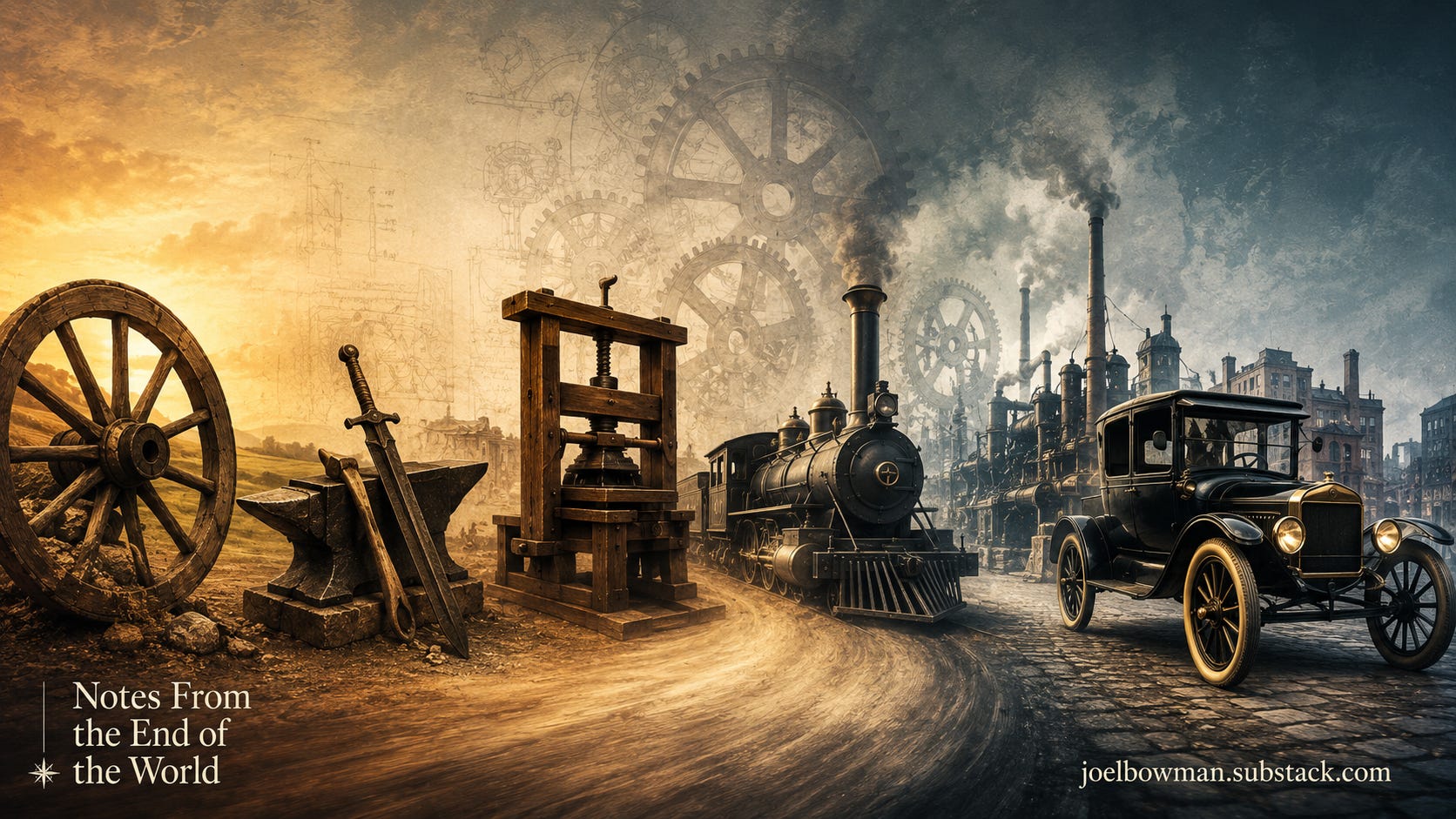
“The future’s uncertain and the end is always near.”
~ The Doors, Roadhouse Blues, from the album Morrison Hotel (1970)
Joel Bowman with today’s Note From the End of the World: Buenos Aires, Argentina...
Once upon a time, the future was a long, long way away. Now, it’s right in our face. Tenacious... hyperactive... and slobbering all over itself... like a puppy dog with six-inch fangs, it’s prone to bite the hand that feeds at some point.
Here’s the latest from Big Tech’s bleeding edge, from the usual outlets...
“Wall Street giants partner with Nvidia on $500bn AI financing deal” ~ Financial Times
“AI can design new viruses. That’s not as scary as it sounds.” ~ The Washington Post
“Engineers build world’s first portable diamond-powered quantum computer — it works at room temperature and can be plugged into an outlet” ~ Live Science
But amidst all the fanfare surrounding our gee-whizz technology and whizz-bang artificial intelligence, are we getting any closer to knowing where we’re actually going?
Our guess (subject to change, correction, and complete and shameless revision, without notice or apology):
No.
From Socrates to Morrison
More on the future in due course. First, let us return to a subject in which we are far better versed: ignorance.
Naturally, we approach the matter warily and with due reverence, mindful not to get ahead of ourselves, lest we end up claiming to “know that which we do not know.”
Besides, what would be the point of such a cheap conceit? Not knowing is, after all, the humble origin whence all valid inquiry undertakes its long and winding path of discovery.
And if Jim Morrison was right, and “no one here gets out alive,” who in his level mind would want to rush the journey anyway? We’ll gladly take our time, thank you very much.
Peering in the opposite direction, then... we notice that even today’s multi trillion dollar Big Tech breakthroughs began from astoundingly modest settings. In ancient times, new ideas and novel technologies often took centuries... even millennia... to “break on through to the other side.” (And yes, we’re listening to a Doors mix as we type to you today...)
It was our distant forefathers, roaming the fields of Mesopotamia and the great Eurasian steppes, who probably developed one of the simplest machines of all: the wheel. That was around 3,500 BC. Today’s Zoomer generation might be forgiven for thinking such a disruptive tech would quickly roll out across the continent... and yet, it took centuries to make its way across Europe... and something like a thousand years to reach Britain.
The same goes for iron smelting, which the Hittites in Anatolia mastered sometime around 1,800 BC. The superior technology gave them a huge advantage over their bronze age neighbors in developing stronger farm tools and weapons to make war. And yet, such a game changing advancement did not reach Europe until the Hallstatt culture (of central Europe) for another thousand years.
Nor were such delays solely due to the physical nature of these breakthroughs. The alphabet, which the Phoenicians pioneered around 1200 BCE, probably to help them keep track of trade shipments across the Mediterranean, took 400 years before it was adapted into the Greek “alpha-beta,” then another couple of hundred before it morphed into Latin, and so on across the continent.
So too for steelmaking… glassmaking… paper… stirrups… gunpowder… and on, and on. Each took centuries to spread beyond the immediate area of discovery.
Informational Escape Velocity
Part of the sluggish nature of dissemination was due to the ancients’ lack of shared scientific language. What was obvious to the Egyptians was literally indecipherable to the Celts, and what was already commonplace to the Babylonians remained a mystery to generation upon generation of neighboring civilizations. There were simply no cheap and cheerful means of “mass information transmission.”
So mankind trudged on... tossing virgins into volcanoes and cursing the clouds for their failed crops.
It was not until the Renaissance in general... and Johannes Gutenberg’s moveable type printing press in particular... when things really begin to pick up speed. While the Renaissance brought forth a cornucopia of ancient knowledge, Gutenberg’s contraption made it scalable.
For the first time in, well... ever, ideas could be copied en masse and distributed to the four corners of the known world... in multiple languages... simultaneously. And although the ideas of the Renaissance itself, the science, philosophy, art, aesthetics etc., took perhaps 150-200 years to spread from Florence, Italy, to Northern Europe, information itself had already reached escape velocity.
Before long, the Scientific Revolution (~1540–1700) and the Age of Enlightenment (~1680–1800) were taking giant steps for mankind, eventually bringing forth the Industrial Revolution (~1760–1850) with all its spectacular material consequences.
From the steam engines of the mid-18th Century to Carl Benz’s Patent-Motorwagen, man had practically gone from horseback to racetrack in a hundred years. And when Henry Ford put his famous Model T into mass production in 1908, he was well and truly off to the races.
Within two decades, Ford’s factories alone were churning out 2 million cars per year. Counting European expansion and global production in the mid 1920s, the total soon hit 5 million units a year. Averaging a cost per vehicle of $25,000 (adjusted), plus gas stations, roads and bridges, factory capacity, etc., the total value of the auto-industry probably crossed the trillion-dollar mark (in today’s dollars) sometime in the late 1920s- early ‘30s.
It had taken thousands of years for a simple wheel to make its way across Europe... and a matter of decades for tens of millions of internal combustion engine-powered automobiles to thunder across continents the ancients didn’t even know existed.
Technology was speeding up... but even then, a mere one-hundred years ago, it was only just getting started.
But that will have to do for today, dear reader, for the future has indeed arrived... and it smells like dinner. To be continued...
As always, stay tuned for more Notes From the End of the World...
Cheers,
Joel Bowman
There is a book, Barbara Tuchman, “A Distant Mirror,” set in the 1100’s. A time when steel predominated and the wonders of the modern world were not even dreams.
The intent, to demonstrate that human nature has not changed; that we are, in many ways, still, “The Naked Ape.”
The wild card to any prognostication is the behavior of man.
Is technology the new “Tower of Babble?”
I am mesmerized by the “Field of Dreams,” if you build it, they will use it for nefarious purposes.
I contemplate “The Grapes of Wrath;” the tractor and the dollar a day man that plowed lives into the dirt at the behest of bankers.
What is life? Does technology make it better? Once, in the 60’s, I thought so. Now, I am glad my time is short; the world I loved, is gone.
The Great Frisby said, rapes in Britain have gone from 8,000, a year, to 85,000.
IMO one of your best.
I’m going to share this with several of my favorite folk who are innocent of history. It’s tough for them to learn that there are very few new ideas, just new marketing of stoopid ones.