
Happy Race Day!
Columbus in the age of cultural mythologies, national lore and social cohesion...

“Can we all get along?”
~ Rodney King, 1992
Joel Bowman with today’s Note From the End of the World: Buenos Aires, Argentina...
“¡Feliz finde largo!” Our cheerful taxi driver bade us a happy long weekend.
As usual, your clueless editor had no idea what the commemoration was for. (Though, in our own defense, we also have no idea when The Queen’s – ahem… – King’s Birthday is celebrated by our Commonwealth kin. Nor do we much care.)
Later on, over an unhurried copita, a friend explained the local lore to us in fuller detail...
“It’s basically Columbus Day, only we don’t actually call it that, in part because he never actually set foot in Argentina... or anywhere close. Even so, most Argentines still refer to it as the ‘Dia de la Raza’ or ‘Race Day.’”
“Really?” we didn’t wish to appear insensitive. “Sounds... uh, divisive.”
“It is… only it wasn’t always the case. The original celebration was introduced in the early 20th Century. Back then, it was designed to celebrate the Hispanic influence on the Americas. Now, not so much...”
We’ll return to our cultural sensitivity training in a moment... but first, a look at the stories we tell ourselves in order to live together...
In The Beginning…
Every culture has its legends, its origin stories... and its bald-faced lies. The story of Rome’s founding, for example, picks up neatly where Greek mythology left off... at the end of the Trojan War. (Readers familiar with the story are invited to skip ahead a few paragraphs.)
Aeneas, a Trojan prince and the son of the goddess Venus (“culturally appropriated” from the Greek Aphrodite), set sail for home, bloodied and bruised after his epic battle. Following his yearslong seafaring adventures, which conjure images of the more familiar journey made by Odysseus, Aeneas eventually arrived in Latium, Italy (today Lazio), where his descendants settled and became kings.
Several generations later, a princess named Rhea Silvia, a direct descendent of Aeneas, was forced to join the Vestal Virgins, a sacred and, as the name suggests, chaste group of women whose primary role was to tend to the temple’s eternal flame, which represented life in the “Eternal City.”
The vestal scene being apparently too alluring for the fiery-loined god of war, Mars, the immortal paid the princess a conjugal visit, after which she bore him twin sons, Romulus and Remus. Viewing them as a threat to his throne, the princess’s uncle, King Amulius, ordered the babes-in-arms drowned in the River Tiber.
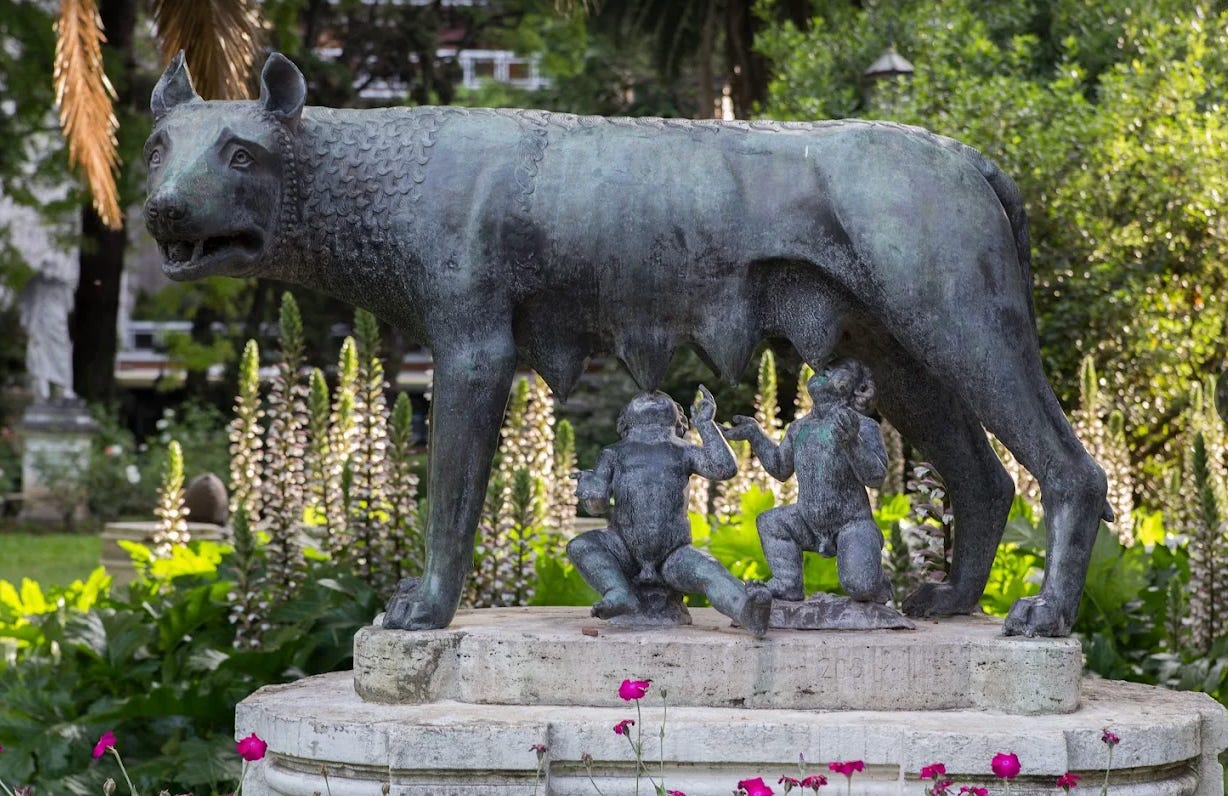
Miraculously, the twins survived and were nurtured by a shewolf (lupa), before being raised by one of mythology’s favorite unsung archetypes, a lowly shepherd named Faustulus. Growing into strapping young lads, the twins eventually overthrew great uncle Amulius and decided to build a city on the banks of the river by which they were saved.
Naturally, the boys failed to agree on which hill to found their new seat of power (Romulus favored Palatine; Remus Aventine). Cue brotherly bickering, in which one twin (Romulus) murders the other (Remus), and you have the founding of a great city, Roma... replete with divine origins, regicide, fratricide, fallen virgins, supernatural pregnancy... and a shepherd. (Plus the rape and pillaging of a nearby village, the Sabines... a non-bedtime story for another time.)
Time Immemorial
From the Egyptians to the Sumerians to the Babylonians... the Greeks to the Romans to the Byzantines... the Abbasidians to the Ottomans to the Spanish... the French to the Mongols to the Ming... the British to the Americans and beyond...
... each country, each culture, hoists its flags, sings its anthems and marches off to war at the sound of trumpets (or gongs, horns, bugles or bells, as the case may be).
And stitching them all together, binding one man to his kin, is a story of their shared sacrifice, their ancestral commonality, their birthright, be it earthly or divine, fact or fiction or, as is usually the case, an admixture of them both. Typically, these fables are designed to pit one group against another, what sociologists call “in” and “out” groups, to foster “social cohesion” within the former... and to form a common and convenient enemy in the case of the latter.
At a national level, the country itself is often anthropomorphized, as in a kind of civic deity, something beyond any one individual. We might think of the Germans, French and Italians siding with The Fatherland (Das Vaterland, La Patrie and Patria, respectively), while the Russians, Chinese, and Indians prefer the loving embrace of their respective Motherlands (Mat’ Rossiya, Zǔguó, and Bharat Mata).
The Americans meanwhile, having abandoned Lady Liberty sometime after 9/11, somehow adopted the gender-neutral, The Homeland.
Notably, however... from the Vandals to the Venetians... the Persians to the Portuguese... the Ming to the Qing and back again... is the common theme of strength through unity.
Even the Romans, who relied upon the recently (ahem...) “abducted” women to broker reconciliation with the jilted Sabine men, managed to promote a general notion of “concordia” (from the Latin con-cordia, literally “with one heart”), to rally the masses.
So where does that leave the popular, post-modern slogan: Diversity is our Greatest Strength? A question to address next week, perhaps...
Meanwhile, let us return to our “Race Day” sensitivity session. Continued our dear friend...
Post Columbus
“Like most of the so-called ‘New World,’ Argentina is largely a nation of immigrants. We are Italians and Spaniards, mostly. But also Germans, French, English. And lately lots of Venezuelans, Paraguayans and Russians, too. Only two or three percent of us actually identify as ‘indigenous.’
“In turn, we all brought aspects of our own cultures with us. Believers and non believers. Christians. Jews. Buenos Aires has the largest Jewish community on the continent, and one of the largest in the world. We also have a significant Asian population. And even an Aussie or two...
“The early idea of Race Day was to celebrate our coming together in a new land, to unite and forge a future with common goals. Fast-forward a hundred years or so, to 2010, when Christina [Kirchner, then President] changed it to ‘Day of Respect for Cultural Diversity.’ Almost overnight, it was out with unity... in with diversity.
“She even had Columbus’s statue removed from down near the Cultural Center, which of course she had named after herself.
“Shortly thereafter, Columbus’s statue was replaced with one of Juana Azurduy, a mixed race ‘mestiza’ woman, half-Spanish, half-Peruvian, who fought for indigenous rights during the wars of independence, especially in Bolivia and Argentina.
“Practically unknown at the time of her death, she has since been elevated to heroine status. Christina’s husband, Nestor, even named the ‘National Programme for Women’s Rights and Participation’ after her. And our last president, Alberto Fernandez, who founded the [since abolished] Ministry of Women, Genders and Diversity, publicly commemorated her birthday...
“Well, that was before he was indicted for corruption and charged with ‘gender based violence’ for striking his wife while she was eight months pregnant...
“As for the statue itself, that was paid for in large part by [then Bolivian President], Evo Morales, who donated a million dollars to its construction. Of course, Bolivia is a hopelessly poor country, enduring its worst recession in forty years, mostly thanks to state corruption... and today, Evo faces charges relating to human trafficking and statutory rape…
“Well, so much for cultural diversity…”
Stay tuned for more Notes From the End of the World...
Cheers,
Joel Bowman
P.S. We are grateful here at Notes for the generous support of our members, who value independent writing and are happy to be part of the pushback against the mainstream media’s mono-messaging.
If you are not already a member, but would like to join our growing community of radical libertarians, skeptical independents and fundamentalist own-business-minders, please consider becoming a Notes member, here… for less than 20 cents per day!
We’re currently #39 in World Politics. The higher we rank, the better our visibility across the Substack network. By supporting our work, you help us reach more readers, delivering the message of free markets, free minds and free people. Thanks in advance! ~ JB
Another fine piece of journalism! I am shocked 🙄 that Morales, the people’s “champion”, turned out to be a scumbag. That was never reported in the NYT! I pray that Milei can keep his own house clean as he power washes the decades of encrusted crud from the Argentine government.
I spent much of my adult life as a (reasonably conventional) American conservative, and thus, as one might expect, fairly patriotic. Over time, however, I came to realize that the modern nation state—and indeed all involuntary governance—is morally impermissible.
So where does that leave me in terms of patriotism? How do I look at “my country” now? I did not sign the social contract by which it is governed, and to which I am forcibly subjected. I have come to realize that while voting may constitute an improvement over the monarchical systems it replaced, it comes with its own morally problematic aspects.
I could go on citing woes, but the gist is this: the range of things about which I feel compelled toward patriotic sentiments has been drastically diminished. So what is left? How should I look at the concept of America now?