
Human Years
Another reason time seems to be "speeding up"...

"I have made this letter longer than usual because I have not had time to make it shorter."
~ Blaise Pascal, from The Provincial Letters (1656)
Joel Bowman with today’s Note From the End of the World: Buenos Aires, Argentina...
The War with Iran... the world’s first trillionaire... SpaceX stock “to the moon” (and back?)... and always, the rise and rise of the AI machines...
We’re not even half way through the year, Dear Reader, and already the memories of six... nine... twelve months ago feel like relics from a quaint and distant past.
Remember the Epstein Files... saber-rattling over Greenland... the abduction of Venezuela’s dictator, Nicolás Maduro?
Recall the Gulf of America brouhaha... shots fired at the White House Correspondents’ Dinner... and “penisgate” at the Winter Olympics?
(Readers unfamiliar with that last item are invited not to Google it... or at least not in a public space.)
Like all the news that’s unfit to print, these stories – and plenty more besides – are now yesterday’s fish ‘n’ chip paper. In this, the Age of Information Abundance, where attenuated attention spans reign supreme and history is that thing each generation ignores so as to repeat the mistakes of the past, we’re already onto “the next thing”... whatever that is.
One has to wonder, with a ceaseless cascade of events pouring over our digital, hand-held horizons, is time really speeding up? Or are we humble observers merely slowing down? (Perhaps it’s a bit of both?)
Man as the Measure
Not so long ago, our literate ancestors used to gaze in wonder at the distant future, visions of the impossible dancing in their heads. We recall a television show from our own childhood, Beyond 2000, which featured flying cars, sidewalk travelators and other seemingly improbable predictions.
What next?
Will our vocation-free children treat us to vacations on Mars, where we’ll enjoy an “earth-downer” cocktail while watching our home planet dip behind the brave new red horizon?
Will the human race have minted its first quadrillionaire, with a near 80-year old Elon Musk having slipped back into the pack of mere trillionaires, the way Harold Hamm (oil), John Malone (cable television), Lex Werner (shopping malls), and other forgotten titans of “old industry” now populate the lower rungs of the world’s richest lists?
What documents will our meddlesome political overlords deem sufficiently benign to declassify by then, once all the crooks and rogues are expired, and will anyone bother to read them, anyway? Or will reading, that antiquated pastime, have gone the way of the dodo?
Perhaps the State itself will have been domesticated by then, relegated to an historical curiosity, one our progeny will study in virtual museums, like they do the pyramids and the pharaohs, wondering how their ancestors ever tolerated such abject abuses of power?
Will the US empire still stand... will its currency hold sway... will the ideas of the west, so hard won, survive to fight another day?
Or will the tides have turned?
A New Suggestion of Time
Outside our window, here in the capital city of an empire that never was, we hear the steady hum of traffic and the honking of horns below. Neighbors and strangers pass one another by; some offer greetings, others are lost in their own thoughts.
Strolling these broad streets earlier today, alone amongst the crowd, we began to reckon on the concept of time itself... that sleepless, eternal trickster.
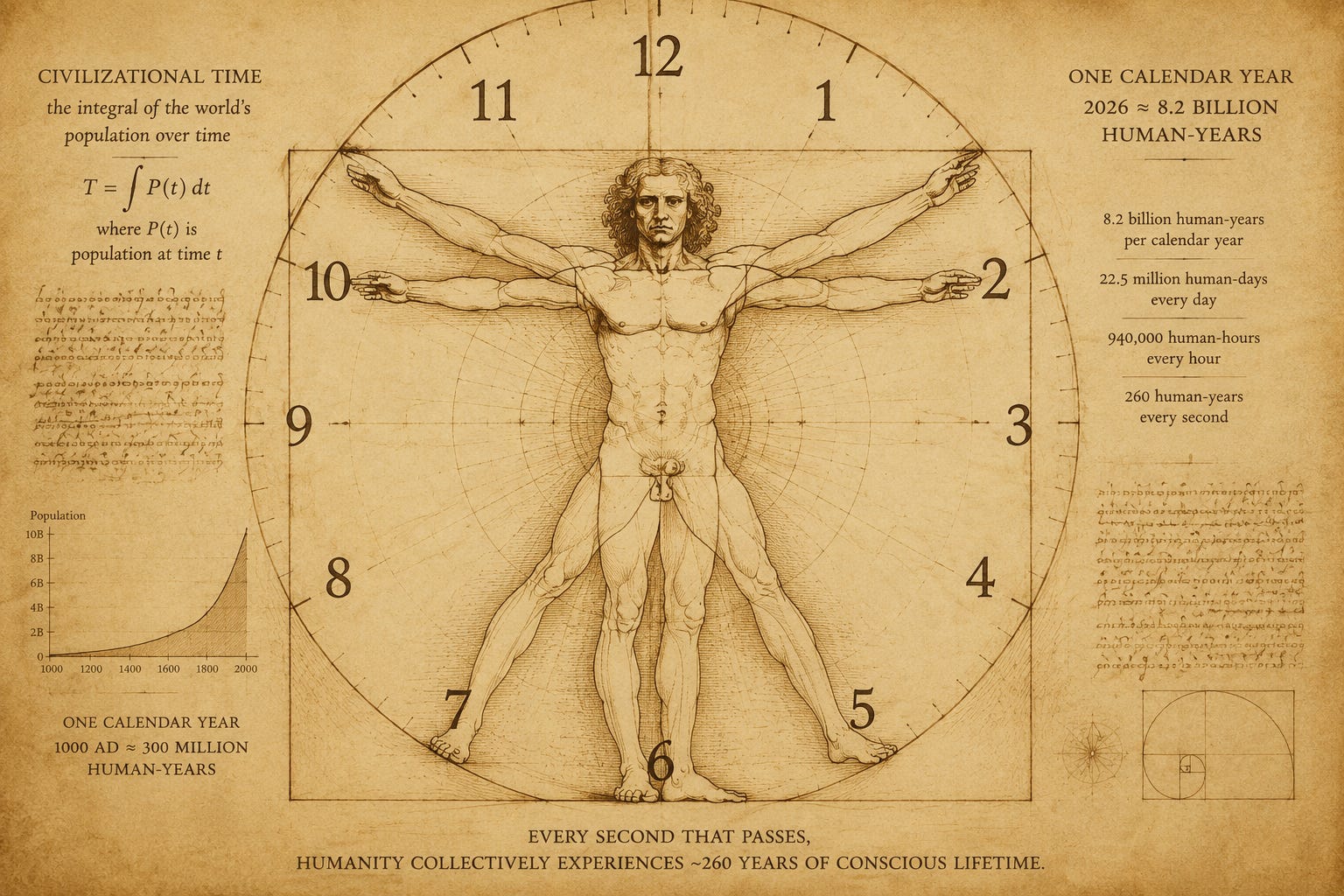
Perhaps one novel way to think about it, given the apparent acceleration of world events around us, is to measure our experience by human years lived. Think of it as adding together every human life being lived in a given moment. We might call this “civilizational time,” for instance, or “aggregate human years.”
For example...
At the turn of the first millennium, New Year’s Eve of the year 1,000 AD, there were roughly ~300 million human beings living on our pale blue dot.
Put another way, we might say that, during that calendar year, our species experienced ~300 million “aggregate human years,” or that ~300 million years passed in “civilizational time.”
That’s how much we lived, collectively, as a species, during the year 1,000 AD. All the births and deaths... the breakthroughs and bruised egos... the grandest campaign to the humblest action... from first kisses to last rights... the sum total of all fears, dreams, desires, of the entire human race: ~300 million human years.
Now, fast-forward to the present. This year, 2026, roughly ~8.2 billion human beings will make the same journey around the sun, and will experience the passage of time, both in their own way and as part of a greater whole. In that way, this calendar year will yield ~8.2 billion aggregate human years, or about 27x more than did a single calendar year just one millennium ago.
And this is all happening every day... every hour... every single minute.
Human Years
Here’s the basic math. Assuming a global population of roughly ~8.2 billion people, humanity is generating approximately:
8.2 billion human-years per calendar year
about 22.5 million human-days every day
roughly 940,000 human-hours every hour
Consider one last figure for just a moment: Every second that passes on Earth, humanity collectively experiences about 260 years of conscious lifetime.
With such a flood of accumulating human experience... this vast multitude of lives unfolding in real time... is it any wonder that civilizational time feels like it’s accelerating at an exponential rate?
Since time immemorial, man has measured time in calendar years because astronomy was the best game in town… or indeed, the universe. Throughout the ages, we have developed other ideas too. Physics has space time… geology has deep time… evolution has genetic time… etc.
But civilization doesn't run on astronomy any more than a tuna keeps time by the opening hours at the local sushi joint. Rather, it runs on human minds. And if that's true, perhaps the relevant measure of time is not so much the orbit of planets overhead or the age of rocks beneath our feet, but the accumulation of human experience itself.
That means more brain surgeons… and more congressmen. More poets… and more prison guards. More genius inventors… and more airhead influencers.
As to where all this leads, to paradise… or purgatory? We’ll look at that next time.
Stay tuned for more Note From the End of the World…
Cheers,
Joel Bowman
P.S. Thanks to all our Notes Members, who’s generous support makes these pages possible. Here’s what a few kind readers have to say about their subscriptions…


Thanks again to ALL our generous members. If you have the time, please consider supporting Free Markets, Free Minds, and Free People, by becoming a Notes Member today…
Human experience: watered down, diluted, dismissed, our experiences are mostly ditched, ignored, tossed away. Rarely do we cultivate wisdom. Many experiences are wasted time because we don’t take the time to reflect on what they mean and where they might lead us. We are in a trance most of the time.
An interesting thought would be to add all the total years lived by the 8.2 billion residents together. For example, total years lived for 10 people of the ages of 10, 35, 50, 55, 60, 61, 67, 70, 71, and 77 would be 556 years. Imagine how large a number total years lived would be for over 8 billion people. We would probably need exponents.