
"On the Other Hand..."
Death by Democracy, the Age of Un-enlightenment and Montaigne's stomach...

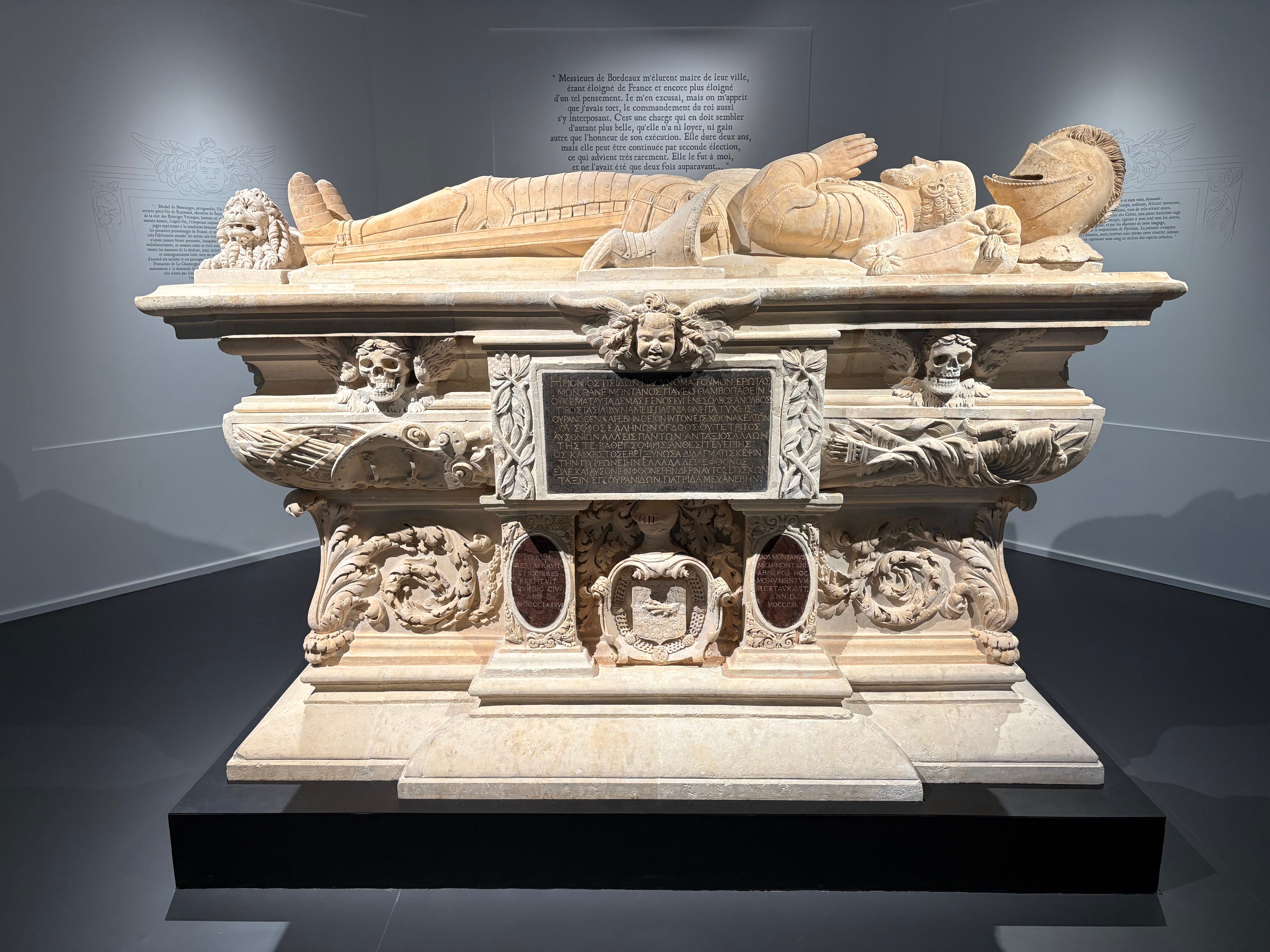
“There is no subject so frivolous that it does not merit a place in this medley... I want liberty to put things in as I please.”
~ Michel de Montaigne, Essays, Book III (1588)
Joel Bowman with today’s Note From the End of the World: Bordeaux, France...
“On the other hand...”
The refrain was overheard, repeatedly, at Le Noailles brasserie yesterday, during an unhurried luncheon. Our agnostic interlocutor, who may be a friend or distant relative, is a cheerful septuagenarian, senior enough to eschew the vapid certainty that so contaminates youth.
Whether discussing philosophy or physics, politics or economics, or simply comparing the magret de canard versus the confit de canard, the gentleman was unfashionably thoughtful.
“On the one hand,” he would begin with a wry smile, “cooking the animals in their own fat has a certain appeal. On the other, given the way they’ve handled the economy these past few years, I might as soon send them directly to the guillotine...”
At some point – between the oysters and the hypothetical severing of various heads of state – the conversation turned to The Enlightenment...
“‘Sapere aude!’ as Kant challenged us. ‘Dare to know!’ Actually, the untraveled Königsberger borrowed the phrase from the great Roman poet, Horace. Nothing new under the sun, you see?
“Still, it’s generally accepted, even amongst thinking people, that ‘progress’ is something we can know and measure. ‘Standing on the shoulder of giants,’ as Newton phrased it, we need only employ our reason, our uniquely human capacity for rational thinking, to advance from A to B... then onto C... and so on and so forth.
“Of course, this all rests on the idea that humans themselves are ‘improvable,’ an assertion that appears to fly in the face of all observable evidence to the contrary. Still, our ‘enlightened’ ancestors saw the history of man as a story of advancement, the triumph of knowledge over ignorance, wellbeing over misery, freedom over tyranny, etcetera...
“But is it really as simple as all that?”
An Acquired Distaste
At this point in the meal, the youngest of the gathered gourmandizers offered a Montaigne-worthy non sequitur, expertly weaving together a tale from the book series Spy Kids, a recent dream about Icelandic horses, and a raw assessment of what it’s like to try an oyster for the very first time: “It’s like eating snot. Really. Why on earth do adults like them so much?”
Following a brief discourse on gastronomy, in which the above-mentioned Montaigne was quoted – “A man may live well without riches, but he cannot live well without a stomach” – the subject veered back to man’s alleged path of progress.
“Take the unenviable task of governance, for example. On the one hand, we might say that it is preferable to have a government that serves the people, as opposed to the other way around. It was Messrs. Locke, with his Two Treatises, and Montesquieu, with his Spirit of the Laws, who did much of the heavy lifting there.
“And let’s not forget that other rapscallion, Rousseau, and his so-called ‘Social Contract.’ Have you ever seen a copy? I haven’t. What kind of contract is it, anyway, where the consent of the parties is merely implied? Ah, but that’s Rousseau for you. A Genevan, mind. And let us say nothing of the man’s advice on child-rearing, nothing Voltaire hasn’t already mentioned...
“But coming to the point... We are supposed to have a government ‘of the people, by the people and for the people.’ And democracy is held up as the process by which such an arrangement is delivered. At least, that’s the idea. Progress, remember?
“Now, I have little doubt that living under, say, Philip IV, the man they called “the Iron King,” was no picnic. Same for Charles VI, nicknamed “the Mad,” whose delusions brought this land under a brutal civil war... or Louis XI, who earned the moniker “the Universal Spider” after his penchant for spinning webs of psychological intrigue... and torturing his political opponents, sometimes to death. They were mad kings... lunatic dictators... and blood-thirsty sociopaths, all of them.
“On the other hand... at least the people knew what they were up against! Can we really say the same today, standing smugly atop our post-Enlightenment pedestal?
Irrational Reverence
“Today, it is considered right and proper to revere our political class. We refer to them as ‘leaders’ and ‘statesmen’ and afford them all manner of special privilege and status. We bow to them not out of rational fear, but out of irrational reverence.
“And when they rob us, harass us and send our children off to war, do we raise the sharpened blade, ready to deliver France’s closest shave? No. We praise the process by which they were elected... the sacred cow of democracy... and march off to the ballot box to give the next gang their turn at the helm.
“Moreover, in addition to this political Stockholm Syndrome, we appear to suffer a kind of collective identity disorder, too, wherein we mistake our enslaved selves for our very own masters.
“What was it Hillary Clinton said? ‘Our government is all of us.’ And remember Obama, lately in the news, duly disgraced. What was it he used to say? ‘Government isn’t some distant force — it’s made up of us, the people.’
“Well, he’s right about the first part; government is not ‘some distant force.’ Like an object in the rearview mirror, that force is closer than it may appear. It is a direct and immediate force, too, ready to rob, imprison, and even ‘cook in their own fat’ any one of us who doesn’t fall in line.
“As for the derriere-backwards notion of government being ‘all of us’... was it ‘all of us’ who ran our respective countries trillions and trillions of euros into debt? Was it ‘we, the people,’ who opened our borders to millions and millions of illegal immigrants? Was it ‘all of us’ who first created a virus, then used it to lock down the world?
“Who is this ‘we,’ they speak of so glibly? Like Rousseau’s phantom contract, written in invisible ink, I don’t remember signing off on any such matters...
“On the other hand... the Saint-Estèphe pairs perfectly with the duck, and the company of friends and family is not to be improved by talk of politics.”
Stay tuned for more Notes From the End of the World...
Cheers,
Joel Bowman
P.S. We are grateful here at Notes for the generous support of our members, who value independent writing and are happy to be part of the pushback against the mainstream media’s mono-messaging.
If you are not already a member, but would like to join our growing community of radical libertarians, skeptical independents and fundamentalist own-business-minders, please consider becoming a Notes member, here… for less than 20 cents per day!
We’re currently #38 in World Politics. The higher we rank, the better our visibility across the Substack network. By supporting our work, you help us reach more readers, delivering the message of free markets, free minds and free people. Thanks in advance! ~ JB
It has always irked me that structures and other things get named after politicians. Still does. The Founders are excepted.
But airports named after McCain? Reid? The Clintons?…just to name a few. Good grief. Oughta be the US Taxpayer (fill in the blank) Airport
I agree; the Saint-Estephe would pair well with the duck, in either iteration.
On the other hand, the well-deserved punishment for most of the political class is to be the duck (oops,,,did I really say that?) Meaning that the proper role for a former politician is either prison or death. As Mark Twain stated so eloquently, "Every politician deserves two terms. The first in office, and the second in prison." On the other hand, there's no such thing as a good politician; he or she has to steal from someone.