
Running on Empty
Iran, Hormuz and the state of the world...

“War is the realm of uncertainty; three-quarters of the factors on which action in war is based are wrapped in a fog of greater or lesser uncertainty. A sensitive and discriminating judgment is called for; a skilled intelligence to scent out the truth.”
– Carl von Clausewitz, On War (1832)
Joel Bowman with today’s Note From the End of the World: Ormond Beach, Florida...
First, the headlines...
From the Associated Press:
Brent crude briefly tops $119 per barrel before pulling back, and stocks sink worldwide
From the BBC:
Gas price soars over 20% after strikes on Qatar hub
And from Oilprice.com:
$200 Oil No Longer Crazy Idea as Middle East Supply Collapses
Your editor is no geophysicist, dear reader, but we know enough about the matter to understand that, reduced to its most basic equation, all life depends on energy. That goes for the fat and the skinny... the old and the young... Republicans, Democrats and unreconstructed anarcho-capitalists alike.
The Age of Abundance
When energy is cheap, reliable and abundant, life on planet earth flourishes, as it has done, more or less unabated, since Colonel Edwin Drake sank the first commercial oil well in Titusville, Pennsylvania, back in 1859.
The ensuing Age of Energy Abundance has seen the world population grow by more than 7 fold, from about ~1.2 billion people when first Drake got to drilling to over ~8 billion today.... even as the percentage of the global population living in poverty has declined precipitously during that same period.
In 1820, somewhere between 80-90% of all people on earth lived in what is today categorized as “extreme poverty.” That percentage in 2026: < 8%.
The global economy is able to sustain such plenitude because it, too, has grown exponentially thanks to an abundance of cheap, reliable energy.
Back in 1850, the world’s entire economic output was equal to roughly $1.2 trillion (measured in today’s dollars). Today, global economic output is orders of magnitude greater, with estimates in the range of ~$170 trillion in 2024.
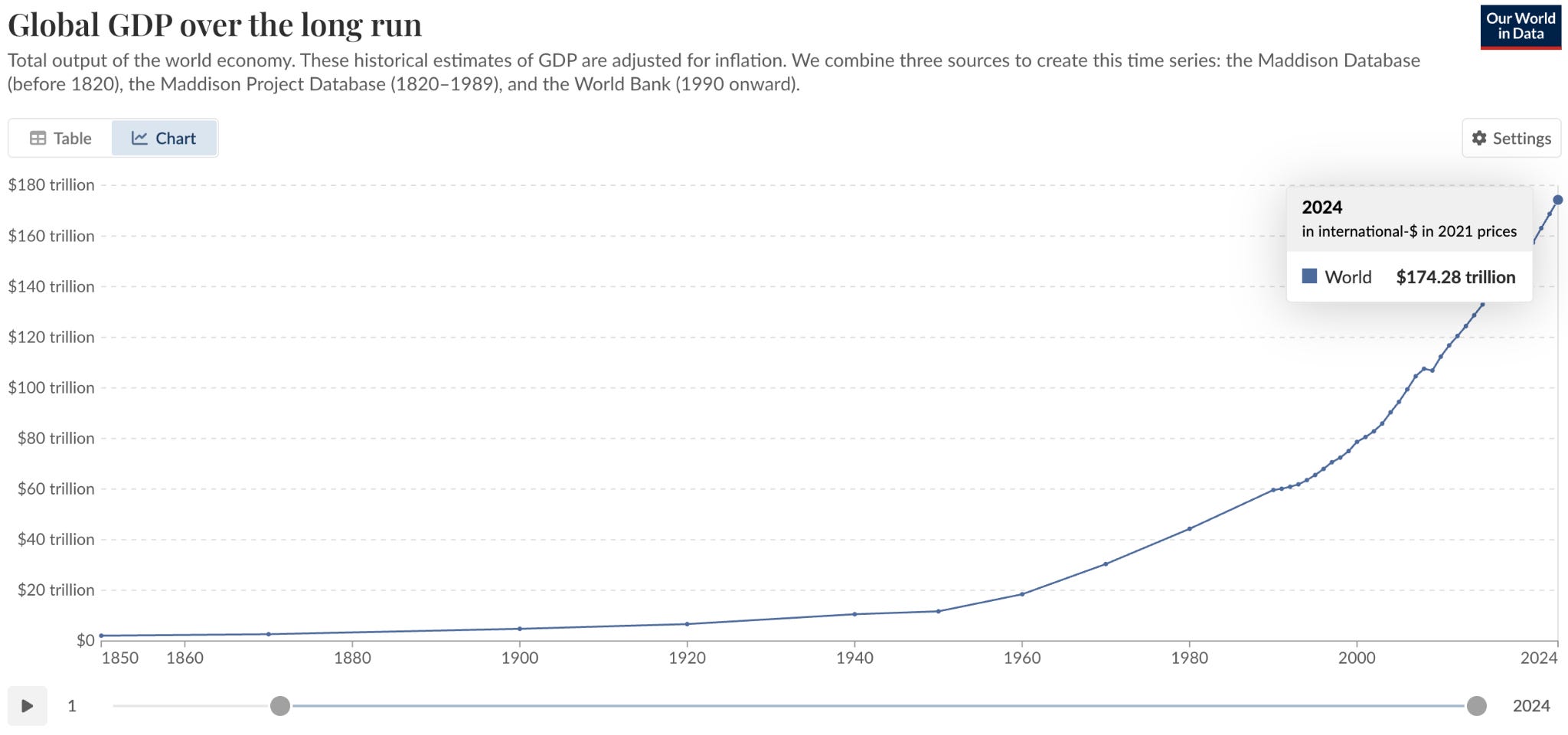
In other words, while the population has grown by ~7x... the size of the economy in which they live, love and loathe has mushroomed over ~145x, meaning per capita GDP has increased about ~22x during the same time.
Human life expectancy has doubled during that time... from about ~30-40 years in 1850, to roughly ~75 years today. Child mortality has fallen by 90%, from four in ten children dying before reaching adulthood (mostly during birth), to four in 100 today.
All this while per capita electricity consumption has increased between 10x and 20x since 1900. That’s no coincidence.
When energy is cheap, reliable and abundant, life flourishes. When energy is expensive, unreliable and in short supply... things get difficult, quickly... MN Gordon explains in today’s article (below)...
A Trend Reversal
Of course, not all countries will be impacted in the same way and at the same time during the energy crunch. Indeed, some who were last are suddenly finding themselves, if not quite first, rapidly advancing along the line.
Here’s Argentina’s energy trade balance over the last few years, as compiled by Econométrica, based on official INDEC figures. The figures shown are in billions of dollars. (Note that the shaded areas, 2026-227, are projected figures.)
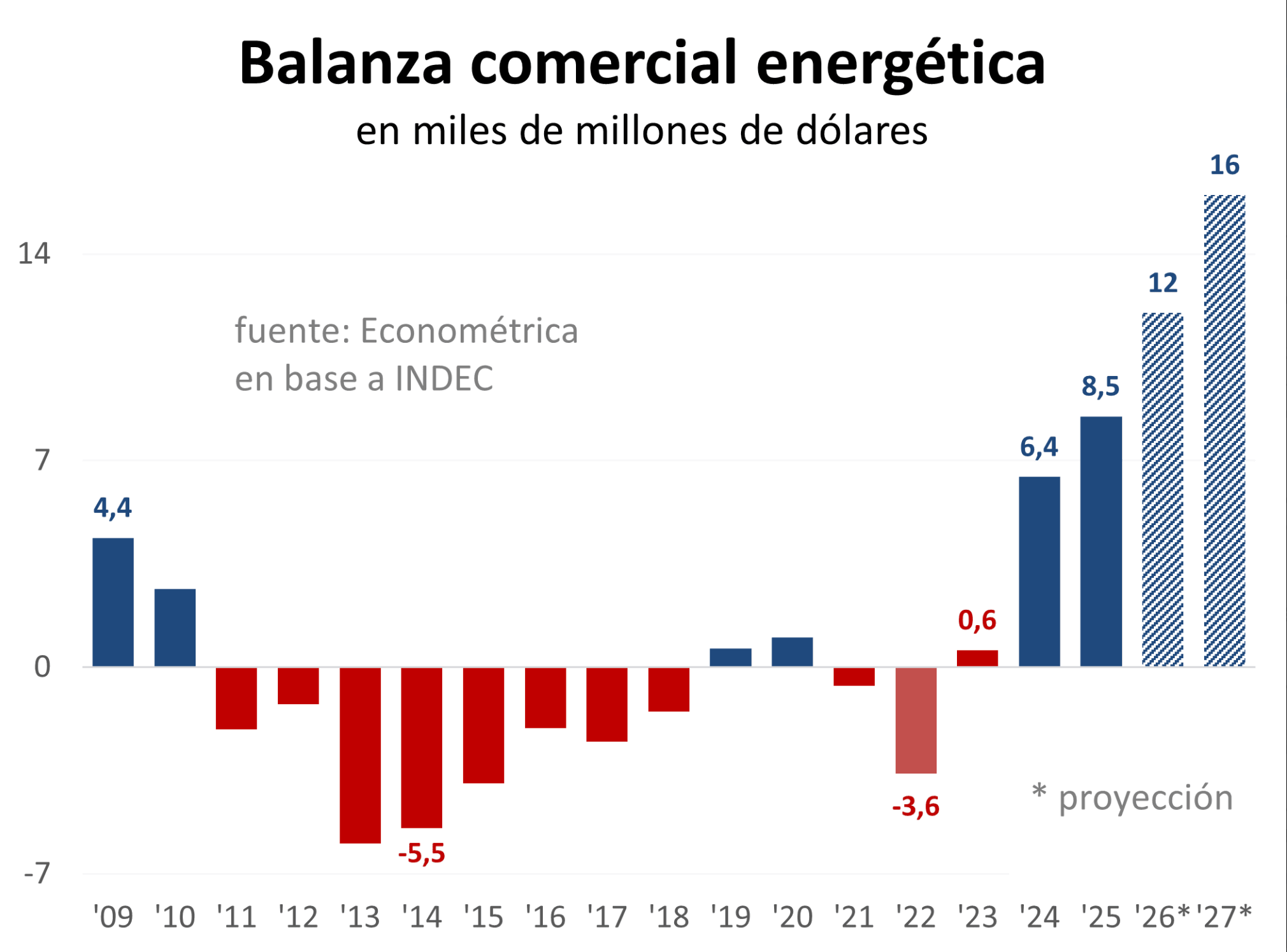
And here’s the latest from Infobae (translated):
Driven by rising oil prices, Argentine exports could exceed USD 100 billion for the first time in 2026.
With a barrel of crude hovering around $100—and the expectation that it will remain at elevated levels for several months—foreign oil sales are poised for a substantial increase, rising from a projected $12.5 billion to a staggering $17 billion. An additional jump in agricultural exports is also anticipated, as commodity prices have likewise been on a sustained upward trend. It is estimated that, in this sector, the increase would amount to approximately $1 billion.
The consequence of this surge in energy and agricultural sales is that Argentina’s total exports could, for the first time in history, surpass the $100 billion mark.
The more the end of the world looms, the more the End of the World looks like the place to be...
Meanwhile, read on for Mr. Gordon’s column below, and don’t forget to check out his excellent site, Economic Prism, for more of his fine work.
Running On Empty
by MN Gordon, founder of Economic Prism
The opening bombardment of Operation Epic Fury on February 28 succeeded in taking out the heart of the Iranian regime. But it also triggered extreme geopolitical instability in the Middle East and severed the aorta of the global economy.
The massive barrage of missile strikes, the chaotic swarm of counter-drone attacks, and the succession of Mojtaba Khamenei offer sensational headline material. Yet the real destruction, the kind that reshapes civilizations, isn’t happening in the smoky ruins of Tehran. It’s happening in the empty shipping lanes of the Strait of Hormuz.
Skyrocketing oil prices are a noted precursor to declining economic activity. Higher gas prices are not just an inconvenient market fluctuation. They act as a regressive tax on every single human being who eats, moves, or buys things. When the price of gas spikes and the pumps run dry, the very foundation of the global economy crumbles.
As of March 19, Californians are already paying $5.60 per gallon to fill up their cars. That may seem like a lot if you’re living elsewhere. In the south, for example, we’re paying $3.22 per gallon.
But according to the math of human survival, $5.60 per gallon is still the bargain of a lifetime. It’s a clearance sale on the very substance that built the modern world.
As the supply of oil is disrupted across the globe, we’re about to learn a painful lesson. That the modern economy has been living off an unearned inheritance of energy productivity. Without this liquid gold, the cost of everyday convenience, from overnight shipping to fresh fruits and vegetables in February and central air conditioning, would be utterly impossible.
Pistons vs. Perspiration
When the math of energy’s boiled down to its crystalline essence, a great disparity is discovered. Cheap, abundant petroleum has detached people from the physical reality of work. The actual costs to move a mountain or even a minivan have been obscured.
Splitting wood with an axe, for example, is much harder than using a gas-powered log splitter. Assuming a $20-an-hour labor wage, let’s look at the engineering reality.
A single gallon of gasoline contains roughly 33.7 kilowatt-hours (kWh) of energy. To put that in perspective, a healthy human being, working a grueling 8-hour shift of manual labor, produces about 0.6 kWh.
Do the math (33.7 divided by 0.6). One gallon of gas does the work of 56 days of back-breaking human labor.
If you pay a worker $20 an hour to do what that gallon of gas does, you aren’t paying $5.60. You are paying for 448 hours of labor. Thus, at $20 per hour of labor, the real value of a gallon of gas, in terms of human effort, is $8,960.
Even when accounting for the inefficiency of small internal combustion engines (at roughly 25 percent), that gallon is still doing the work of 112 hours of manual labor. That puts the fair price of gasoline, the price where human sweat is finally competitive with a piston, at $2,240 per gallon.
When you drive to Starbucks for your morning cup of coffee, you aren’t just burning fuel. You are burning the equivalent of a man working for two weeks straight to push your 4,000-pound SUV to the drive-thru window.
Over many decades, the precious utility of gasoline has been taken for granted. But the Strait of Hormuz is now closed. Soon enough, it will become very apparent how little can be accomplished without the aid of refined petroleum.
Approaching the Caloric Cliff
Yet the closure of the Strait doesn’t just mean you can’t afford to fill up your gas tank. It means the world can’t afford to eat. Energy and food are often thought of as two different cornerstones of civilization. But, in reality, they’re the same thing.
Impacts to the supply of oil and gas lead directly to impacts to the supply of fertilizer and food production. You can’t have an abundance of food brought to market when the tractor has no diesel and the soil has no nutrients.
About 30 percent of global nitrogen and phosphate fertilizer transits the Strait. What’s more, in the Northern Hemisphere, it’s currently the spring planting season. The most vulnerable moment in the calendar.
Natural gas doesn’t just heat homes. Rather, it’s the primary feedstock for urea. Without it, crop yields dramatically decline – often by half or more. By this, we are looking at a significant reduction in global grain carry-over (storage inventory) if this blockade lasts through April.
In addition, as the petrochemical industry halts, the miracle of the Green Revolution, which allowed 8 billion people to exist on a planet that naturally supports far fewer, disappears. The world population for most of human history was capped by the amount of nutrient rich soil, water, and sunlight that were available. That cap was busted through in the mid-20th century thanks to fossil fuels.
Without synthetic fertilizers, energy powered water conveyance pump stations, and diesel-powered tractors, the carrying capacity of planet earth drops by billions. The caloric math simply becomes too small a number to provide the sustenance everyone needs to live.
In short, the entire agricultural infrastructure is a mechanism for turning fossil fuels into calories. When the fuel stops, grocery store shelves go empty.
What’s the backup plan?
Running On Empty
Markets reacted favorably last week to the G7 and the International Energy Agency (IEA) proposals for a coordinated release from the Strategic Petroleum Reserve (SPR). Something on the order of 300 to 400 million barrels has been mentioned.
This is massive. Nearly double the emergency release of 2022. It makes good headlines. And helped ease the price of a barrel of WTI crude from $115 to below $90... for a day or two.
But, once again, the math reveals a great disparity. The Strait of Hormuz isn’t just a small spider vein. It’s the aorta main line artery. With it closed, the world is staring down a shortfall of roughly 20 million barrels per day (mbd).
If the G7 and IEA actually manages to dump 400 million barrels into the market, that historic intervention covers the gap for exactly 20 days. That’s it. Less than three weeks of breathing room.
And that’s assuming the logistics even work. You can’t just press a magic button and have 400 million barrels appear where it’s needed.
The maximum drawdown rate for the U.S. SPR is only about 4.4 mbd, and the rest of the G7 nations have even tighter bottlenecks. It’s physically impossible to pump the oil out of the reserves fast enough to replace what used to flow through the strait.
The SPR was designed for basic supply disruptions. A hurricane in the Gulf. Or a pipeline strike. It wasn’t built to subsidize a global blockade of the world’s energy aorta.
If Operation Epic Fury isn’t over in three weeks, the G7 will be running on empty. At that time, it will become lucidly clear what happens when over a century of energy abundance vanishes.
The impacts are both countless and extreme. For starters, the futile chickens of building cities in deserts, developing sprawling suburbs, and just in time delivery of food to market will come home to roost.
Regards,
MN Gordon, Founder of Economic Prism
Joel’s Note: What do you reckon, dear reader? Are we headed for a protracted energy crunch, like the oil shock of the 1970s? Which countries stand to gain from higher oil prices... and which will lose out in the reshuffling? Or will the whole thing be over in time for the Donald to take a victory lap before the midterm elections?
Have your say in the comments section, below…
Thanks again to MN Gordon for his timely guest column. Gordon is the founder and author of the excellent Economic Prism newsletter. We’re happy to bring you his work from time to time, not because we have any financial arrangement with him (we don’t), but because it’s thought-provoking and we think you might enjoy it, too. Cheers ~ JB
Nothing Gordon said is incorrect. Fossil fuels are, indeed, finite. The energy sky however, is not falling. The straight has been a problem for a long time.It will not extend into crushing danger territory. The world will not allow it.
Using fossil fuels to produce electricity is stupid. Much of our infrastructure around the world relies on it for a simple energy production. We need to wake up and get back to nuclear. It's safe, it's environmentally sound and it preserves the fossil fuels needed to produce fertilizers, clothing, lipstick and the very screen that I am tapping on now.
It's almost as stupid as growing corn to produce ethanol. 🤔 Let's use diesel, fertilizer, trucks hauling billions of bushels of corn to processing plants that consume outrageous amounts of energy to produce alcohol from corn. It's a circle of inefficiency, doom and stupidity on a global level.
One thing to learn from what's happening in the M.E. right now is the damage that Iran can impose on the entire world by shutting down the Strait of Hormuz. Before, it was just hypothetical, now it's there for all the world to see. Having the "aorta" of the world in their hands does not bode well, whether that be right now or in the future. I don't know how we walk away now and let them regain that control. Even if you wipe out their ability to ever manufacturer nuclear weapons, they now understand that they have the ability to do far more global damage than a few nuclear weapons ever could. It sounds like we have about two to three weeks to figure this all out, and even then, the fertilizer situation is probably a lost cause for this planting season in the Northern Hemisphere.