
Canon Fodder
What to read: A guide for mere mortals

“The nature of peoples is first crude, then severe, then benign, then delicate, finally dissolute.”
~ Giambattista Vico
Joel Bowman with today’s Note From the End of the World: Buenos Aires, Argentina…
Something a bit different for you this weekend, dear reader…
While the talking heads and opinion-mongers blather about the latest Orwellian “two minutes of hate,” we thought we might instead offer something a little more… timeless.
Spared as we are the inconvenience of immortality, and its literally never-ending to-do list, man is nevertheless obliged to contend with the myriad shortcomings of his own fleeting existence… one of which is expressed in the perennial question, “What should I read?”
As our late grandmother-in-law (a librarian who would have been 100-years young yesterday), was fond of saying: “So many books, so little time!”
In honor of Grandma Jeanie, and her centennial birthday, we present a brief essay on the Western Canon, for your learned consideration. Please enjoy (and feel free to list your own “must read” authors and/or books in the comments section, below)…
Canon Fodder
By Joel Bowman
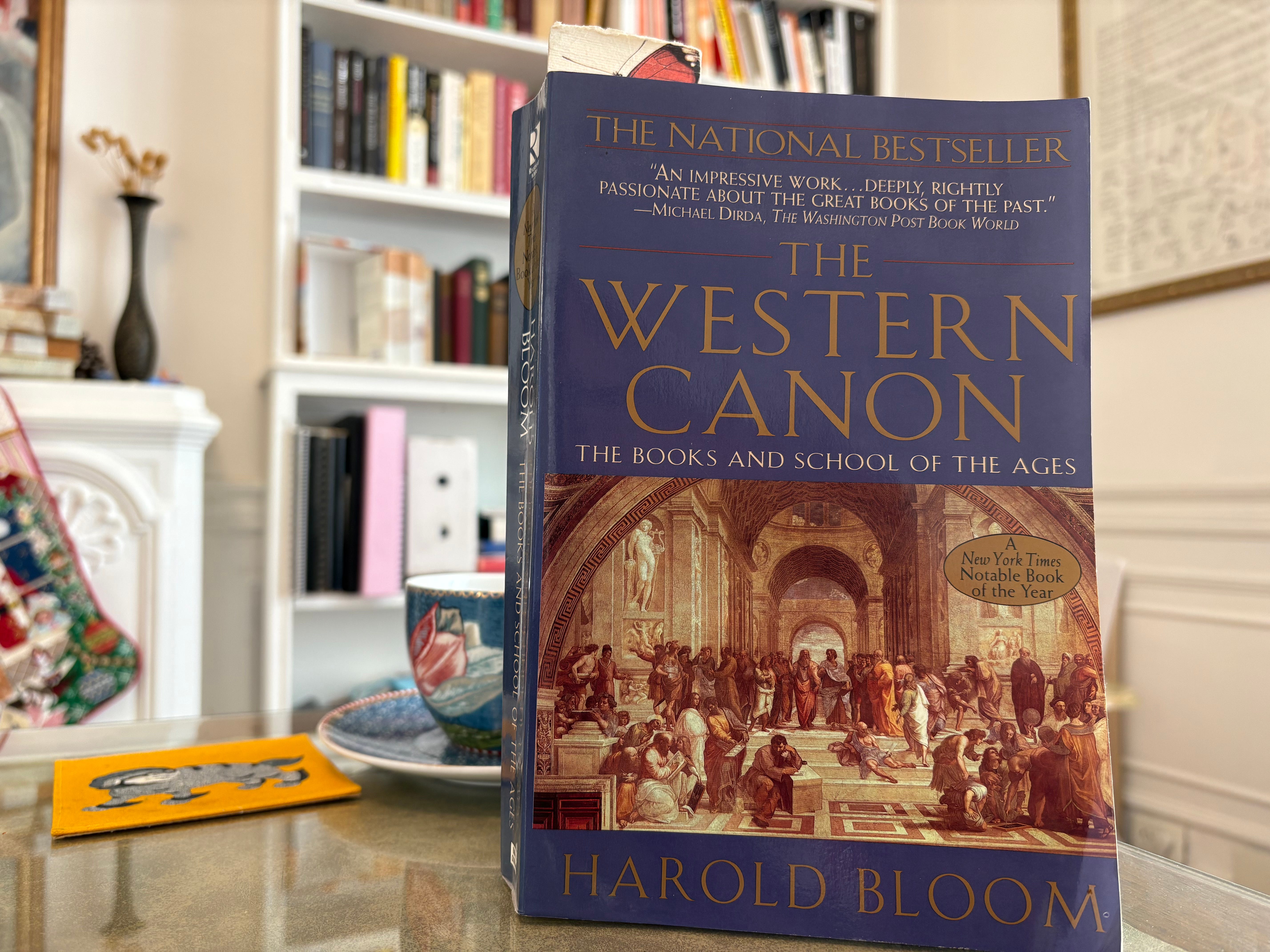
When he set out to compose his own magnum opus, The Western Canon, The Books and School of the Ages, the man many considered to be the world’s greatest living reader faced a task even the eponymous hero of his beloved Odyssey would have found daunting. By the early nineties, Harold Bloom (1930-2019) had been Professor of Humanities at Yale University for as long as anyone could remember; certainly long enough to know that any attempt to assess the literature of the ages by pure aesthetic value would be met with Charybdian howls and Scyllian gnashing of teeth, especially from those he referred to as the “School of Resentment.”
But for Bloom, for whom it could almost have been said there was “nothing left but to reread,” the labor was one of unadulterated love. To hear him describe the art of deep reading (especially of poetry) is to listen to man himself enraptured, whose cumulative decades of reading had suspended him somewhere between the world of the living, breathing, flesh-and-blood humans who sought his opinions, his attentions, his contributions, and the parallel, though no less crucial to him, worlds of Shakespeare, Dante, Goethe, Shelley, Cervantes, Ibsen, Joyce...
Infinite Time
If mortality did not concern us, reasoned Bloom, if we truly dwelled among the Gods, there would be scant need for us to be so judicious in our reading selection, to jettison the trendy in favor of the time-tested, to allow for fleeting considerations other than true aesthetic merit. Writes Bloom:
What shall the individual who still desires to read attempt to read, this late in history? The Biblical three-score and ten no longer suffice to read more than a selection of the great writers in what can be called the Western tradition, let alone in all the world’s traditions. Who reads must choose, since there is literally not enough time to read everything, even if one does nothing but read. Malarmé’s grand line – “the flesh is sad, alas, and I have read all the books” – has become a hyperbole.
This from a man who could read 400 pages in an hour, without sacrificing comprehension. Someone, who had not only learned Shakespeare’s poetry by heart, but who appeared sometimes to dwell himself among the Bard’s cast of characters, and whose students used to challenge him by quoting Milton’s Paradise Lost, mid-sentence, and then watching, entranced, as he picked up the thread and followed it until the end of Yale’s quads without breaking his stride. The Englishman’s epic stands at just beyond 10,000 lines. Bloom, seemingly, stood amidst them all.
In marshaling the 26 writers he considered to be at the core of The Canon, Bloom followed in Joyce’s Wake (Finnegans, that is) and looked to the above-mentioned Italian philosopher, Giambattista Vico (1688-1744), for inspiration. In his New Science, Vico had posited a cycle of phases to explain the course of history – Theocratic, Aristocratic, Democratic and Chaotic, out of which a new Theocratic Age would emerge. Bloom commences his own Aristocratic Age with Shakespeare, “because he is the central figure of the Western Canon.”
Herewith, Harold Bloom’s Twenty Six...
William Shakespeare
Dante Alighieri
Geoffrey Chaucer
Miguel de Cervantes
Michel de Montaigne
Molière
John Milton
Samuel Johnson
Johann Wolfgang von Goethe
William Wordsworth
Jane Austen
Walt Whitman
Emily Dickinson
Charles Dickens
George Eliot
Leo Tolstoy
Henrik Ibsen
Sigmund Freud
Marcel Proust
James Joyce
Virginia Woolf
Franz Kafka
Jorge Luis Borges
Pablo Neruda
Fernando Pessoa
Samuel Beckett
Aside from the tawdry, now almost compulsory “representational” criticisms of The Canon, namely that it ought to be based on arbitrarily selected demographics rather than aesthetic merit, perhaps the pettiest attack is that it presents a poor or wayward moral, social, political, etc. compass. Bloom himself preempts this assault in his elegiac opener, drawing attention to the undeniable and under-celebrated fact that, “The West’s greatest writers are subversive of all values, both ours and their own.”
Know Thyself
It is not within the works themselves that we search for guidance on such “real world” matters, in other words, but in the private dialogue they inspire us to conduct internally, something akin to what Socrates would have called the inner voice, or “Daemon.” Writes Bloom:
Scholars who urge us to find the source of our morality and our politics in Plato, or in Isaiah, are out of touch with the social reality in which we live. If we read the Western Canon in order to form our social, political, or personal moral values, I firmly believe we will become monsters of selfishness and exploitation. To read in the service of an ideology is not, in my judgment, to read at all. The reception of aesthetic power enables us to learn how to talk to ourselves and how to endure ourselves. The true use of Shakespeare or of Cervantes, of Homer or of Dante, Chaucer or of Rabelais, is to augment one’s own growing inner self. Reading deeply in the Canon will not make one a better or a worse person, a more useful or more harmful citizen. The mind’s dialogue with itself is not primarily a social reality. All that the Western Canon can bring one is the proper use of one’s own solitude, that solitude whose final form is one’s confrontation with one’s own mortality.
For the mere mortals among us, who lack access to a Bloomian photographic memory and fall well short of Malarmé’s hyperbolic lamentation, “confrontation with one’s own mortality” seems a perfectly suitable rationale to undertake a canonistic approach to deep reading. And once we have examined and reexamined all the stars in that bright sky, there’s always Bloom’s quartet of appendixes, which guide us through Vico’s Theocratic, Aristocratic and Democratic Ages, into our Chaotic present, before launching boldly into the Canonical Prophesy beyond.
Happy reading.
And now, returning to the world of petty human affairs… this week, we examined the nature of “work,” what is means to be a selective Luddite, and where “time’s roaring loom” of technological progress may lead us yet. Please enjoy, below…
And now for your Notes From the End of the Week…


Final Notes…
What say you, dear reader? Does Professor Bloom manage to capture the “Best of the West” with his 26 “must read” authors? Or is there space for someone else, someone he overlooked?
Not including Dostoyevsky seems, to your editor, like something of a criminal omission. And what about Gustave Flaubert… Anton Chekhov… Thomas Mann… ?
You’re already thinking of others, no? Drop their unsung names in the comments – and make your case for who they should supplant, and why – below...
And as always, stay tuned for more Notes From the End of the World…
Cheers,
Joel Bowman
Adam Smith. Ludwig von Mises. Friedrich Hayek.
According to the Laboratory of Neuro Imaging at the University of Southern California, the average brain generates 48.6 thoughts per minute—amounting to about 70,000 thoughts per day
The human brain weighs about 3 pounds and is 75% water, yet it uses 20% of the body's total energy and oxygen. It generates electricity comparable to a 25-watt lightbulb, contains 100 billion neurons, and can feel no pain itself, though it interprets pain signals from the body. It's also incredibly complex, with 100,000 miles of blood vessels and the ability to create new connections throughout life.
As standard practice except as say savants and others of neurological variances display, our brain it is deluged with all the input data from sight, sound, smell, touch senses that then are filtered, subliminally categorised, recorded filed and stored for immediate or later use.
At times whether by deep search, consciously and then often again subliminally, data is called up attached one to another, for that phenomenon of joining dots, discovery or other mental shenanigans
Where thus for many of we, whom toil to live out and participate in each day, measured as being 86,400 seconds, is it possible to engage in the erudite engrossing and time consuming option of absorbing the complexity and extensive words, vocabulary and prose of the multitude of scholars, writers and sages over the eons?
That it is oft for many mortals no more than the occasional word-snacking of wordsmiths, rather than banquet of reading to orgy propensity of the elite, given the multiple tasks that our 3 pounds of mostly water, 100,000 miles of blood vessels and internal flashing sparks, is required to manage, it is really not that surprising to me that there are many books in my library that are not read or will not get read.
And when all is said and done …
"What an astonishing thing a book is... one glance at it and you're inside the mind of another person, maybe somebody dead for thousands of years. Across the millennia, an author is speaking clearly and silently inside your head, directly to you. Writing is perhaps the greatest of human inventions, binding together people who never knew each other, citizens of distant epochs. Books break the shackles of time." - Carl Sagan